
Nothing Phone 4a Marketing
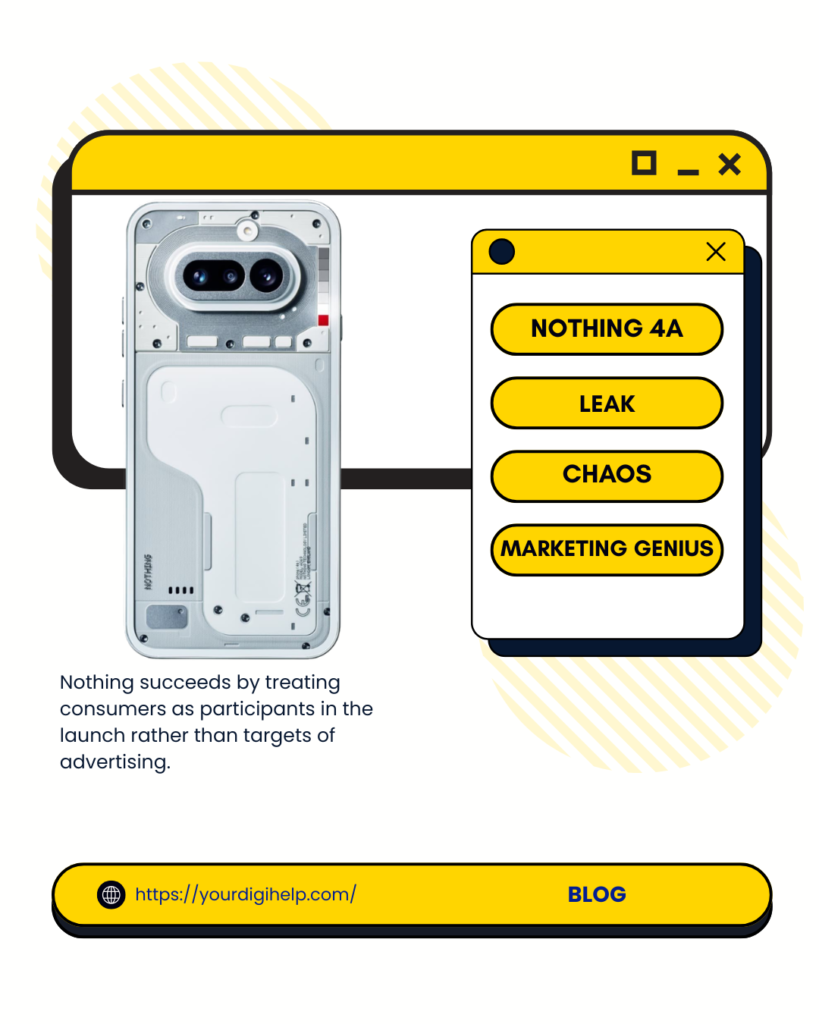
How Nothing Sold the 4a Without Selling It:The Phone That Launched Itself Walk through Shoreditch in London right now and you will see them. Posters slapped on bus shelters. Stickers on lampposts. A storefront drenched in bubblegum pink. There are no price tags. No specifications. Just a date: March 5. This is not how phones usually arrive. Most companies spend millions telling you why you need their product. Nothing has spent the last three months making you ask them if you can have it. The Nothing 4a campaign is a reversal of the traditional sales funnel. Instead of pushing information outward, they have created a vacuum that pulls you inward. The First Move: Taking Control of the Noise Let us address the elephant in the room. The Nothing 4a leaks. If you follow tech Twitter, you have seen the posts. Some say the battery is 5000mAh. Others say 4800mAh. One leaker insists on the Snapdragon 7s Gen 4. Another is equally certain it is a Dimensity chip. This looks like chaos. It is not. The Nothing team understands something important about human psychology. Certainty is boring. Doubt keeps you refreshing the page. Over the past ninety days, the volume of conflicting rumors about the Nothing 4a has actually increased as the launch date got closer. That is not how leaks usually work. Usually, the picture becomes clearer. Here, it became fuzzier. Look at the timing. Every time a major leaker posted something incorrect, Nothing’s social media accounts went quiet. No corrections. No clarifications. Just silence. That silence was interpreted by the community as confirmation. The community then argued about it. Those arguments created threads. Those threads created visibility. Nothing did not stop the leaks. They outgrown them. The Visual Campaign: Pink as a Statement On February 25, the company released images of the Nothing 4a in pink. This was a gamble. The brand built its identity on transparency and monochrome minimalism. The Phone (1) and Phone (2) were grey and white. The Ear and Ear (a) were clear plastic. Color was the enemy of sophistication. Or so we thought. The pink Nothing 4a is not a pastel. It is not a rose gold. It is a loud, confident, almost aggressive pink. In the marketing images, it sits against dirty concrete walls and spray-painted plywood. It looks like something that belongs in a record store, not a phone shop. The company explained the technical process behind this color. Lucy Birley, who leads their color and materials team, described it as a “desaturated red” that changes depending on how light hits the layered resin underneath the glass. This detail matters. It gives the people who buy the phone something to talk about. They are not just buying a pink phone. They are buying a specific engineering choice. This is the difference between a trend and a product. The Glyph Gets an Update When Nothing launched its first phone, the Glyph Interface was dismissed as a gimmick. LED lights on the back that flash for notifications? Nice party trick, critics said. It will wear off. Three years later, the Glyph is the visual anchor of the Nothing 4a marketing. Over the last ninety days, the company has slowly revealed changes to this system. The LED strip has been redesigned into a 1×6 configuration. This is not random. It allows for more complex light patterns and better battery efficiency. In their marketing materials, they show the Glyph responding to music. They show it pulsing during charging. They show it as an indicator for the camera countdown. The message is consistent: this is not decoration. It is communication. For the Nothing 4a, the Glyph also gains a practical function that the marketing team is leaning into heavily. The red recording indicator. When you record video, a small red light on the back tells everyone around you that the camera is active. This is privacy protection built into hardware. It cannot be disabled by software. It cannot be hacked. By marketing this feature, Nothing positions the 4a as the phone for people who care about security but refuse to carry a brick-like “privacy phone.” It looks cool. It also protects you. That combination is rare. Twitter: The Art of Strategic Silence The Nothing Twitter account has always been different. They banter. They tease. They respond to trolls with emojis. But over the last three months, something shifted. The account became quieter about the product and louder about the culture. When Apple sent out invitations for their spring event, Nothing did not congratulate them. They did not ignore them. They took the invitation, plastered their own “March 5” date over it, and posted it. This is high-risk behavior. It invites comparison. It invites backlash. It also invites attention. The people who loved it retweeted it. The people who hated it quote-tweeted it with angry comments. Both actions spread the date further. This is the core of the Nothing 4a marketing strategy. They are not trying to make everyone like them. They are trying to make everyone look at them. The India Factor: Where the Volume Lives India matters to this launch more than any other region. At the Founders Forum India event earlier this year, Akis Evangelidis, the company’s India President, explained the math. India was not chosen because it was cheap to manufacture there. It was chosen because the early social media followers came from there. The demand was organic. For the Nothing 4a, the India strategy has shifted slightly. The phone is expected to cost more than the 3a did. Component shortages have driven prices up globally. In a price-sensitive market like India, this could have been a disaster. The marketing team solved this by shifting the conversation. The Indian campaigns do not lead with price. They lead with design and the “Make in India” manufacturing story. They are selling pride of ownership rather than value for money. Early indicators from the Nothing India community page suggest this is working. The pre-launch discussions are