
Google Discover Just Changed Everything: February 2026 Core Update: A Complete Guide for Publishers
If you run a website, you already know the feeling. You wake up. You check your analytics. Google Discover sent you 500,000 visitors yesterday. Today it sent you fifty.
Table of Contents
ToggleThe feed has always been a roller coaster. No logic. No predictability. Just spikes and crashes that make publishers feel like they are gambling rather than building a business.
On February 5, 2026, Google decided to fix that. They rolled out a Core Update aimed specifically at Discover. Not search. Not images. Just that volatile feed sitting on millions of Android home screens.
Lets see what changed, why it changed, and what you need to do about it.
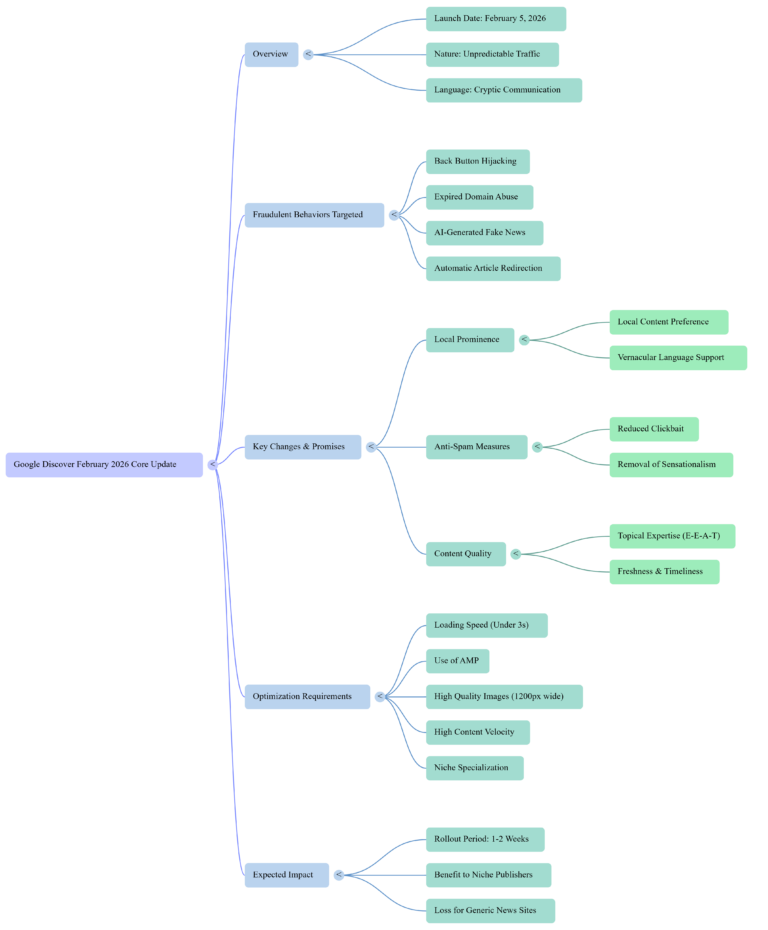
The Tricks That Finally Got Google's Attention
For years, bad actors treated Google Discover like an ATM with no security camera. They found loopholes. They exploited them. They made money while legitimate publishers watched their traffic get stolen.
Google noticed. And now they are responding.
When the Back Button Becomes a Trap
You have experienced this yourself. You are scrolling Discover. You see an interesting headline. You click. You read. You hit the back button to return to the feed.
Nothing happens.
You are stuck on a random homepage. Or a different article entirely. The website hijacked your browser history to keep you on their page longer. It inflates their metrics. It ruins your experience.
Google is finally killing this practice. Websites using back-button hijacking will see their Discover traffic disappear entirely.
Dead Schools Coming Back to Life as Fake News Factories
Here is a tactic that sounds like a movie plot but happens every day.
Someone buys an expired domain. Not just any domain. A domain that used to belong to a reputable school. A college. A university. The domain has history. It has authority. Google trusts it.
The new owner fills it with AI-generated garbage. Celebrity death hoaxes. Fake car launches. Divorce rumors that never happened. The stories are designed for one purpose only. Clicks.
Readers see the trusted domain and click without thinking. They land on a page full of ads. The spammer gets paid. The reader gets fooled.
Google’s update targets these expired domain abusers specifically. If your website exists purely to repurpose old authority for new lies, the Discover feed will lock you out.
The Bait-and-Switch That Tricks Everyone
This one is sneaky.
A user clicks on an article about a new phone launch. The page loads. But the article is not about phones. It is about a celebrity breakup. Completely different topic. Completely different headline.
How does this happen? The website coded the page to load a different article than the one the user clicked. The user, confused, hits back and clicks again. The same thing happens. Maybe they give up. Maybe they stay. Either way, the website just doubled its click metric on a single user.
Google now treats this as fraud. If your site swaps articles on users, Discover will stop sending you traffic.
What Google Wants to Show Instead
Punishing bad behavior is only half the update. The other half is promoting the right kind of content. Google made three priorities clear.
Your Local News Just Got a Promotion
If you live in India and follow tech news, your Discover feed has probably been dominated by American and European sites for years. The same happens in Bangladesh. In Nigeria. In Vietnam. Global publishers swallowed the local feeds.
That changes now.
Google will prioritize local and vernacular websites for users in their own regions. A publisher writing in Bengali for readers in West Bengal will rank above a London-based tech site for those same readers. A news site in Dhaka will show up before a news site in New York.
For local publishers, this is the best news in years. For global sites, it means traffic from foreign countries will drop.
Clickbait Headlines Stop Working
Sensationalism has been the default setting for Discover content since day one. You Know What Happens Next. Doctors Hate This One Trick. What Happened Next Will Shock You.
These headlines exist because they worked. People clicked. Google noticed the clicks and sent more traffic.
But clicks are not the same as satisfaction. Users clicked the headline, read three sentences, and left. They felt tricked. Google finally decided that tricking users is not a sustainable business model.
The update explicitly targets clickbait. If your headline promises what your article does not deliver, Discover will stop delivering you.
Niche Experts Take the Spotlight
Here is where the update gets interesting for publishers who actually know their stuff.
Google now evaluates your website topic by topic. Not as a whole. By individual subjects.
Imagine you run a general news website. You cover politics well. You cover sports well. But once a month, someone on your team writes a food article. A recipe for biryani. A list of best restaurants in your city.
That food article will struggle in Discover now. Google will look at your site and see limited food expertise. It will send that traffic instead to a dedicated food blogger who publishes recipes every day. Someone who lives and breathes cooking content.
The message is clear. Stick to what you know. Depth beats breadth.
What Publishers Must Do Now
Reading about algorithm changes is easy. Adapting to them is hard. Here are the technical and content shifts required to survive this update.
Speed Is Not Optional Anymore
Your website needs to load in two to three seconds. Not five. Not four. Two to three.
If your current hosting setup cannot deliver that, you have two choices. Upgrade your infrastructure or implement AMP. Accelerated Mobile Pages load almost instantly because they strip away the heavy code that slows normal pages.
There is no third option. Slow sites will not appear in Discover.
Images Need to Be Big and Clear
Blurry thumbnails kill clicks. Google knows this.
Every article you publish needs a featured image at least 1200 pixels wide. Not 800. Not 1000. 1200 minimum. The image must be sharp. It must be relevant. It must make someone scrolling past want to stop and look.
If your images are small or fuzzy, Google will show someone else’s article instead.
You Have to Publish Like Your Traffic Depends on It
Because it does.
Google used the term “content velocity” in their update documentation. It means how frequently you publish. And how consistently.
Posting four articles a month will not keep you in Discover. Posting ten high-quality articles a day within your specific niche might. The feed rewards freshness. It rewards volume. It rewards commitment.
If you cannot maintain that pace, focus on quality over quantity in a smaller niche. But do not expect Discover to send you traffic for occasional publishing.
Write for Humans, Not Algorithms
This sounds obvious but it gets forgotten constantly.
Your articles need to be readable. Real sentences. Real paragraphs. Real value. Google can measure engagement now. They know when users scroll quickly and leave. They know when users stay and read.
If your content exists only to fill space and host ads, Discover will phase you out. If your content genuinely helps or entertains someone, Discover will keep showing it.
Three Questions Publishers Are Asking Right Now
The update is still rolling out. It will take one to two weeks for the full effects to settle. But specific questions are already emerging.
Does Content Velocity Help New Websites?
Yes, but with a warning.
A new website publishing ten excellent articles a day in a focused niche can gain traction faster than ever. Google wants fresh content. They want consistent publishers. A new site that commits to daily publishing signals reliability.
However, velocity without quality fails. Publishing ten thin articles stuffed with keywords will not work. The articles must demonstrate expertise. They must serve the reader. New sites that understand this can grow quickly. New sites chasing volume alone will crash.
Will Multi-Niche News Sites Lose Traffic to Specialists?
Almost certainly.
The general news site that occasionally posts recipes will lose food traffic to dedicated food bloggers. The tech site that occasionally posts movie reviews will lose entertainment traffic to film critics.
But here is the nuance. If your multi-niche site builds deep expertise in each category separately, you can survive. You need dedicated writers. Dedicated sections. Dedicated expertise signals. Google will evaluate each topic area independently. Strong performance in one category does not guarantee strong performance in another.
What Technical Steps Ensure 1200px Images?
Two things matter here.
First, train your content team. Writers and editors need to know the minimum width. They need to check images before publishing. No exceptions.
Second, implement automated checks. Your content management system can flag images below 1200 pixels before publication. Plugins exist for WordPress and other platforms that enforce size requirements. Use them.
Also consider image compression. A 1200px image should not slow your site. Compress it without losing quality. Tools like ShortPixel or TinyPNG handle this automatically.
The Waiting Game
Rollouts take time. You will not see changes overnight. Your traffic might fluctuate for two weeks while Google adjusts and readjusts.
Do not panic. Do not make drastic changes based on a single bad day.
Watch your analytics. Look for patterns. Which articles lost traffic? Which gained? The answers will tell you what Google values now.
If your traffic drops, ask yourself hard questions. Are you publishing consistently? Are your images large enough? Is your site fast? Do you demonstrate real expertise in your topics?
If the answer to any of those questions is no, you know what to fix.
The Bottom Line
Google Discover was unpredictable for years because Google tolerated behaviors they should have stopped earlier. That tolerance ended on February 5.
The feed will still be volatile. That will never change completely. But the volatility will follow rules now. Publishers who follow those rules can build sustainable traffic. Publishers who ignore them will fade out.
Speed matters. Image size matters. Publishing frequency matters. Expertise matters. Local relevance matters.
If you focus on those five things, the update does not threaten you. It rewards you.
This article was prepared at yourdigihelp. We track algorithm changes, test strategies, and build tools to help publishers navigate digital marketing. Visit yourdigihelp daily for free SEO tools and the latest updates on Google Discover, Core Updates, and traffic growth strategies.